The merchant accused the mayor of Hrelstakov
The Government InspectorThe merchants’ complaint to Khlestakov gives the town’s abuses a concrete public voice, but it does not bring the residents the justice they seek. They describe a Mayor who requisitions goods, imposes soldiers on their households, and treats lawful obedience as no protection from his demands. Yet the supposed inspector hears their appeal through the same corrupt logic that has shaped the town: he says he will not take a bribe, then accepts their money as a loan. The scene converts a plea for relief into another payment to a powerful official.
The inspection and the merchants’ opportunity
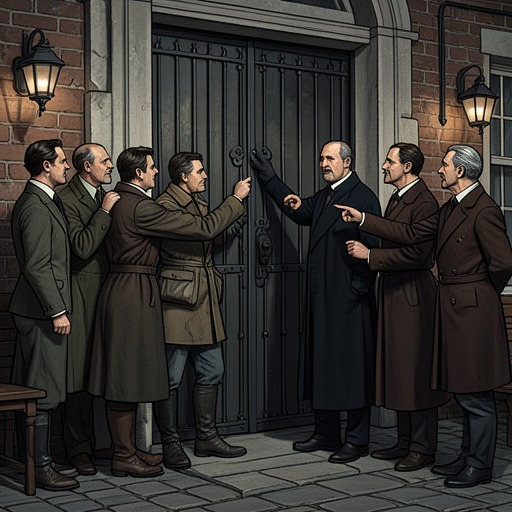
The merchants approach Khlestakov while he is being mistaken for an inspector from Saint Petersburg, supposedly sent incognito with secret instructions to examine the government. The Mayor’s alarm over that inspection has already prompted efforts to control what the visitor might see and hear. He orders officials to manufacture signs of activity, directs them to insist that everyone is satisfied, and threatens those who might say otherwise. The merchants therefore address a man whom the town’s officials believe can expose or punish them, even though their estimate of his authority is mistaken.
That mistaken identity gives their complaint its immediate stakes. The merchants ask Khlestakov not to ruin them and say that they suffer undeserved insult and injury. Their petition is not an abstract accusation: they want the Mayor removed from their lives, and they appeal to the visitor as someone with the power to make that happen. Their deference reflects the hierarchy surrounding the inspection. They call him their worship and father, placing their hopes in a superior whose real position they do not know.
What the merchants report
The merchants’ account describes several forms of coercion. The Mayor, they say, quarters soldiers on them, a burden they compare to being put in a noose. He grabs one of them by the beard and calls him a Tartar. They insist that they have obeyed the laws and regulations and have shown no disrespect, presenting their compliance as evidence that the punishment they endure is not a response to wrongdoing.
They also describe how the Mayor takes goods from their shops. He sees a piece of cloth, orders that it be taken to his house, and receives nearly forty yards of it. The merchants say they do not object to providing clothing for his wife and daughter, but that accommodation does not satisfy him: he takes whatever catches his eye. Their testimony thus distinguishes between an acknowledged demand and uncontrolled appropriation. The point is not simply that the Mayor accepts gifts, but that he treats the merchants’ property and labor as available to him at will.
The accusation is especially pointed against the Mayor’s own presentation of himself as a public servant preparing for scrutiny. He has told his officials to present a show of order, while privately arranging to conceal neglected duties. He reminds them that a church funded five years earlier was never begun, and instructs them to claim that it had been started and then burned down. Against this managed account of civic administration, the merchants supply details of what the Mayor’s rule means in their shops and homes.
A complaint turned into a payment
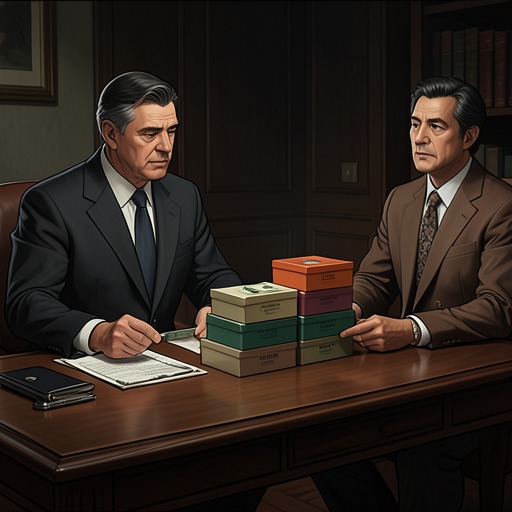
The merchants ask that the Mayor be sent away, preferably as far from the town as possible, and offer bread and salt along with a basket of wine and sugar loaves. Khlestakov refuses to call what they offer a bribe. He says that he would accept a loan of three hundred rubles, and the merchants respond by offering five hundred instead. He accepts, allowing the exchange to proceed under the more respectable name of a loan while the practical result remains a transfer of money from petitioners to an authority they hope will help them.
The episode’s irony lies in the gap between the merchants’ urgent expectation and Khlestakov’s actual conduct. They believe they are addressing a powerful inspector; he is an impostor, and his response is not a considered investigation of their evidence. Their offer of money, made in the course of seeking redress, becomes an opportunity for him to obtain funds. The distinction he draws between a bribe and a loan changes the wording, not the transaction. The people who describe themselves as wronged must pay again in the hope of escaping the person who has wronged them.
Other appeals and the limits of redress
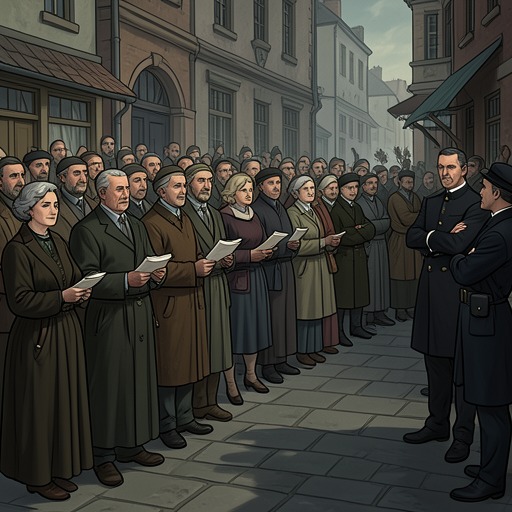
The merchants’ testimony belongs to a larger sequence of complaints to Khlestakov. A locksmith’s wife says the Mayor ordered her husband to be shaved for military service before his turn, despite the law protecting a married man from that treatment. A widow reports that she was flogged. When she asks for a fine to be imposed for the mistake, explaining that the money would be useful to her, Khlestakov tells her he will see to it. These appeals add distinct alleged abuses to the merchants’ account: arbitrary conscription, physical punishment, and a request for compensation after the harm has already occurred.
Together, the complaints expose the contrast between formal rules and local power. The merchants invoke laws and regulations, and the locksmith’s wife invokes the law governing her husband’s eligibility for military service; their testimony nevertheless describes decisions enforced by the Mayor rather than restrained by those rules. The Mayor’s fear of inspection produces staged appearances and threats, while the residents seek relief through the presumed authority of the inspector. But the merchants’ payment shows how little protection that arrangement guarantees. Their complaint makes official abuse visible, yet the scene’s immediate consequence is not a demonstrated remedy: Khlestakov takes their money, and the petitioners remain dependent on his promise to act.